Tuesday, December 29, 2009

The Revenge Of The Lady Fighter (1973)

The Revenge Of The Lady Fighter

Philippines 1973 colour

Fullscreen, dubbed into English

aka Buhawi, Revenge Of Lady Fighter

Director “Junar”/Jun Aristorenas Story/Screenplay Greg B. Macabenta

Cast Virginia, Rolando Gonzalez, Teroy de Guzman, Ernie Ortega, Rudy Rolloda, Ruben Ramos, Palito

ladyfighter1

After a small village is attacked by a gang of vicious bandits, one of the village women, Rosa, is saved by mysterious martial arts master Ming, who offers to teach the men of the village the art of unarmed combat. Initially sceptical, Ming soon persuades them by punching a few of them and tossing them around a little. As they train themselves to fight, however, the bandits are scheming to return to their village and plunder it once more.

ladyfighter4

Ming gives the men of the village some medallions - symbols of their loyalty, righteousness, and transformation into a fully-trained fighting force - and makes them promise never to use their skills for evil or revenge. And sure enough, when the bandits return, they get a severe beating and run crying back to the chief goon. "We'll kill the men, women and children. They will all pay for this," he vows. Although armed with huge machetes, the bandits are no match for the villagers, and even Palito gets in on a little monkey-style kung fu action. However, the villagers break their vow and, egged on by head villager Nardo, kill off the remaining bandits, despite Ming's protests, with only good-guy Lewel refraining from the bloodshed. "He was an enemy, yes. But he could no longer fight you. He was begging you to spare his life," moralises Rosa.

ladyfighter7

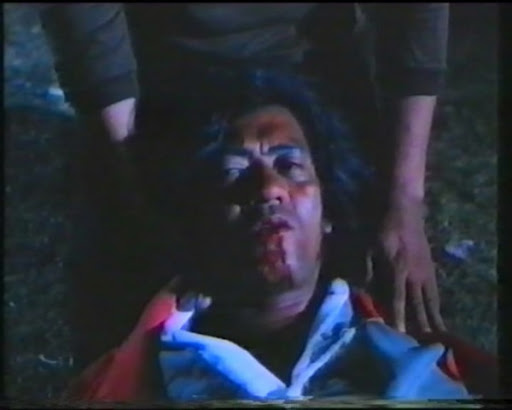
When the villagers return home that evening, flushed with victory and booze, Nardo attempts to drag Rosa away and have his wicked way with her. After Ming beats up the unruly mob, Nardo sneaks up behind him and stabs him in the back with a machete. Ming dies with a warning on his lips: "This evil thing is just the beginning..."
ladyfighter11

With Palito looking on and wincing from time to time, Rosa begins training herself to avenge Ming's death, including some King Boxer-style iron palm training, and the classic 'mediating under a waterfall' bit that no martial arts training montage is truly complete without.

vlcsnap-1142132

Meanwhile, Nardo and his gang invade a house in the woods and relieve it of all its money and valuables; it has an armed guard, so they were probably ill-gotten gains anyway. They then hijack a bus, which seems less justifiable, as it doesn't seem to be full of drug dealers or anything. Clad in black uniforms, they are now known and feared as 'The Black Gang'.

ladyfighter13

Lewel, who is now a policeman, and Rudy (who I don't remember being in the film before, but the film itself seems to think otherwise, so who am I to argue) meet Rosa and Palito in the woods and get down to some light exposition. It seems that Nardo's gang has recently incorporated some other band of goons, and that Lewel has been charged with the task of tracking them down in Bicol. Rosa offers to come with, but Lewel tells her it's too dangerous. Exposition over.

ladyfighter2

Lewel and Rudy find members of Nardo's gang in the woods and try to take them in, but they put up a big stinker of a fight, and both Rudy and Lewel are wounded. Rosa shows up in the nick of time, though, and beats Nardo's man into the ground in the film's most exciting and sustained fight scene so far. Just as she's about to deliver the fatal blow, Lewel reminds her that killing goons just isn't cricket, so she makes do with taking his medallion from him.

ladyfighter14

Rosa then sets about putting an end to Nardo and his criminal shenanigans, making her way, in classic kung fu style, up to the final villain as though climbing on a ladder of severely battered goons...
ladyfighter12

One interesting thing about this film is that the villains which our heroine is forced to confront are the same people who, in the start, were themselves the helpless victims of rapacious bullies; not exactly standard fare for a martial arts revenge picture, although you can see a similar thing going on in Tyrone Hsu's 'The Assignment'. Nardo's gang even wear the medallions given to them by Ming, highlighted by their black outfits, which seems a deliberate mockery of Ming's values and a twisted inversion of everything he tried to teach them.

ladyfighter3

The fight scenes aren't as well-conceived or as crisply executed as they are in their Hong Kong counterparts; in the first half of the film, before Rosa joins in the fray, all the fights are big rollicking stuntmen brawls, but they're good fun nevertheless. Once Rosa gets her fu on, however, the fight scenes improve by several hundred percent, as Virginia, an experienced action star, brings not only a practiced athleticism to her fights, but also a kind of intensity bordering sometimes on desperation. Her hunger for revenge is palpable, and her frustration at being denied the satisfaction of killing is quite persuasive.

ladyfighter15

The Revenge of a Lady Fighter doesn't seem to be the original title; the Hong Kong distributors, M/S Mirabelle International, have clearly added the red title cards (the first of which reads 'Revenge of Lady Fighter', while the second more accurately reads 'The Revenge of the Lady Fighter') to the title sequence, so it's not clear yet what the original title was. None of the films listed in the available information online seem to match, and the only review I can find is a disapproving little squib in German. Even the year of release is no better than an educated guess. Another curiosity we can probably thank the HK distributors for is that the film opens with a scene that occurs chronologically much later in the film. This is presumably to get the attention of the audience and reassure them that there will, in fact, be a lady fighter somewhere in the film, and that in the course of the running time, she will exact a certain amount of revenge. This counter-intuitive technique of hooking the audience with footage taken from the last third of the film was much loved by Sandy Frank, who distributed a lot of of Toho and Daiei monster films in the sixties and seventies.

ladyfighter6

Directed by 'Junar' (Jun Aristorenas) and starring his wife Virginia, The Revenge of the Lady Fighter is a thoroughly entertaining film, and a surprisingly obscure one. Despite the arguably regional bursts of humour from Palito (and another comic actor I haven't identified), this is a supremely exportable film which could have played anywhere there was an audience for martial arts revenge films. Incredibly (considering this is the husband-and-wife team behind Batwoman and Robin Meet the Queen of the Vampires), there are no wild leaps of improbability or savage assaults on credulity, there are no eyesores of low production value, and even the dubbing, although heavily accented, is intelligible and rarely silly (although I did smile somewhat when the police chief told Rosa "I am clothing you in the authority of the law"). So it's hard to imagine why even among fans of kung fu films this is a practically unknown film, as it's a solid pleasure to watch. (Robert Harkin)

Monday, December 28, 2009

Hercules In The Haunted World (1961)


Hercules In The Haunted World

Italy 1961 colour

Fullscreen, dubbed into English

aka Hercules In The Center Of The Earth, Ercole Al Centro Della Terra, Hercules vs. The Vampires

Directors Mario Bava, Franco Prosperi Writers Mario Bava, Sandro Continenza, Franco Prosperi, Duccio Tessari

Cast Reg Park (Hercules), Christopher Lee (King Lico), Leonora Ruffo (Princess Deianira), George Ardisson (Thesus), Rosalba Neri (Helena)


We backtrack a few years in the Mario Bava filmography to 1961, and an early film for Bava as director. By the time Hercules In The Haunted World was released the sword and sandal (or “peplum”) genre was at its midpoint, with Italian production companies turning out one sausage-meat-squeezed-into-a-human-skinsuit actioner after the other. Only a few rise to the top of the B-film mudpool to be recognized as minor classics, and this, my dear Schlock fiends, is one of them.


The story is pure peplum with little deviation from the rules. Demigod Hercules travels to the kingdom of Ecalia with his friend Theseus to be reunited with his love, the king’s daughter Diarina. After fending off would-be assassins, he arrives to find the king dead and Diarina in a death-like trance under the control of her regent uncle Lyco (a creature described as “the spirit of evil on Earth” played, appropriately enough, by Christopher Lee). The film unfolds as a predictably mythic quest to find a magic rock from Hades, the world of the dead presided over by the god Pluto, to restore Diarina to life.


It all sounds like a hundred muscleman actioners and that’s exactly how we’d remember it without director Mario Bava at the helm. Bava had worked as cinematographer on some of the more strikingly visual sword and sandal films of the late Fifties. Hercules In The Haunted World was his first as director, and despite an embarrassingly low budget to work with, the talented cameraman was able to work miracles. Aside from the creepy studio-bound sets bathed in gels and dry ice, there’s subtle camera movements and breathtaking compositions – take the moment, for instance, when Diarina emerges from her sarcophagus and floats towards Lyco. Then there’s Bava’s trademark macabre touches, like blood seeping from vines holding the souls of the Underworld, and the final journey through Hell is a sight to behold.


British-born Reg Park was a former runner-up to Steve Reeves in the Mr Universe contest before winning the title three times, and so can more than hold his own in the oiled muscleman stakes. As always, Christopher Lee is at his cadaver-like best, playing a semi-dead bloodsucker at the height of his Dracula fame (and pre-empting the film’s alternate title Hercules vs The Vampires). Tragically his distinctive voice dubbed by someone else, and even more disconcerting is his pageboy wig, but these are minor quibbles – it’s a stunning frightfest stapled to a muscleman actioner as we catch Hercules In The Haunted World. (Andrew Leavold)

Primitves (1978)

Primitives

Indonesia 1978 colour

Fullscreen, dubbed into English

aka Primitif, Savage Terror

Director Sisworo Gautama Putra Writer Imam Tantowi

Cast Enny Haryono (Rita), “Berry”/Barry Prima (Robert), Johann Mardjono (Tommy), Rukman Herman (Bisma)


It’s hard to believe that a devoutly religious country such as Indonesia would have such a thriving film industry specializing in sex and horror. Well it does, and next to the Philippines, was one of the largest exporters of genre films. Rapi Films, still Indonesia’s largest film company, was founded in 1968 as an importer of American and European movies. In 1971 they branched into feature films and by the late 70s were successfully dubbing into English their more salacious fare – outrageous gore-soaked horrors, sexploitation and action films – and selling them all over the world. Rapi Films’ own bona fide superstar Barry Prima would feature in most of their exports, such as the 1978 feature Primitives… but more on that later.


Meanwhile the Italians were running around South East Asia creating their own Third World atrocities. The cannibal film, one of the most despicable of horror’s sub-genres, was in full swing, having emerged from the Italians’ own Mondo or Shockumentary genre, in which primitive rituals and nature’s inherent barbarism were packaged with snide narration and pompously ironic soundtracks for modern middle class audiences to be titillated by in the smug comfort of their multiplex. From the Mondo Cane films came Man From Deep River in 1972, a blatant reworking of A Man Called Horse, in which a white man becomes accepted into a cannibal tribe and experiences their savagery first hand. Italian director Ruggero Deodato subsequently delivered a pair of similarly-themed films which would define and dominate the relatively short-lived Cannibal Genre: The Last Cannibal World in 1976, and Cannibal Holocaust in 1979. For the next few years, natives chowing down on entrails would become a defining image for not only European but international horror.


The Indonesians decided to beat the Italians at their own game and rip THEIR ideas off for once. Rapi Films set to work to remake The Last Cannibal World on home turf and, for added measure, claimed the story was based on an actual incident (and seriously, from outside Indonesia, how could you ever prove it?). Four anthropology students bribe a guide against his better judgement to take them deep into cannibal territory to peer at the Pangayan tribe close up. Their boat crashes and they’re savaged by wild animals, only to find their hosts aren’t as welcoming as they’d hoped. And while sitting in bamboo cages waiting to be the tribal feast, altruistic thoughts of trying to civilize them turn a little sour…


Deodato’s plot is plundered mercilessly right down to identical scenes and you could almost swear certain shots. Without the director’s flair, however, the entire exercise is stripped back to its basest of elements, though shots of natives chewing the heads off lizards and a mother chewing through her own umbilical cord are made slightly less lurid by the film’s Third World context. Yes, the natives are revolting – and it’s this kind of cultural revolution that makes for some very jarring Schlock Treatment viewing, and not just because of the completely out of place Jarre-like soundscapes and robotic disco. We ask ourselves “who are the real savages” and – holy crap – it turns out to be us, as we chow down on the 1978 Indonesian cannibal flick Primitives. (Andrew Leavold)

The Turkish Superman (1979)

The Turkish Superman

Turkey 1979 colour

Fullscreen, in Turkish with English subtitles

aka Süpermen Dönüyor/”Supermen Return”

Director Kunt Tulgar

Cast Tayfun Demir (Tayfun/Süpermen), Güngör Bayrak (Alev), Esref Kolçak (Profesor Hetin), Yildirim Gencer (Ekrem)


Welcome to filmmaking in a country that doesn’t subscribe to international copyright laws. Welcome to an industry that stole from its Hollywood masters out of sheer survival. Welcome to the wild, wild world of Turksploitation, and welcome to another glorious plundering of late 70s Hollywood, and you have to admire the tenacity of a producer trying to do a Hollywood special effects blockbuster for the price of a can of crab juice. It’s Supermen Return, or affectionately known as The Turkish Superman, featuring a man of steel so odd looking and so expressionless you’d swear he was one of those hypno-dolls hiding behind an enormous pair of toy spectacles.


Plot-wise it’s a direct rip: Superboy’s dispatched from his crumbling planet of Krypton, and is found by a kindly Turkish couple who raise him as their own and call him Tayfun. Once the secret of his past is revealed, he goes to work for a newspaper next to a gorgeous Margot Kidder substitute named Alev, whose father just happens to be Professor Metin specializing in the properties of kryptonite. Naturally there’s an arch villain (complete with villainous black duffle coat) who wants the kryptonite for his alchemy machine, and thus begins an endless succession of kidnappings – first the girl, then the professor, then Superman himself, who’s slowly learning to harness his abilities, including the power to see through women’s clothing.


Is it as bad as it sounds? Well, that depends on your concept of awful. Let’s just say it’s deliriously bad, in the best possible way, and for all its cheapdash chicanery and assiness, it does have an effective moment or two of action. You haven’t lived, people, till you’ve seen the Turkish Superman rear projected onto a dark room full of Christmas decorations, or heard distorted music thieved from at least six James Bond films – and of course the 1978 Superman. Seriously, if Christopher Reeves was alive today he’d be spinning in his wheelchair, and that’s exactly what your head will be doing as we head with capes flying into Turksploitation country with The Turkish Superman. (Andrew Leavold)

Santo vs The Mummies Of Guanajuato (1972)

Santo vs The Mummies Of Guanajuato

1972 Mexico colour

Fullscreen, in Spanish with English subtitles

aka Las Momias De Guanajuato

Director Federico Curiel Producer/Writer Rogelio Agrasánchez Sr

Cast Santo, Blue Demon, Mil Mascaras, Elsa Cárdenas, Juan Gallardo, Carlos Suárez, Federico Curiel (cameo)


By the early Seventies the masked wrestler or Luchador movie was already more than a decade old. The undisputed king, as he has been and will always be, was Santo the Man in the Silver Mask. But there were other masked wrestlers who had proved successful at the box office, particularly Santo's main rival Blue Demon, a thick-set gentleman in a blue mask who since 1964 had notched up an impressive filmography, either paired with the top-billed Santo or in solo outings such as Santo And The Infernal Spiders. Then there was the more gimmicky Mil Mascaras, the Man of a Thousand Masks, a relative newcomer to the business (ring debut in '65, first starring role in '66) whose schtick was to change masks between scenes. Between these three and other wrestling superstars - Neutron, Huracan Ramirez, the list is seemingly endless - the luchador genre ruled supreme on Mexican cinema screens throughout the Sixties.


Like any formula, however, it was destined to grow stale, and ticket sales were on the downhill slide. Pairing Santo and Blue Demon was a winning combination, so enterprising producers such as Rogelio Agrasanchez Sr paired up marquee wrestlers with lesser known names into powerhouse luchadore tag-teams: the Champeons of Justice trilogy featured a revolving stable of Blue Demon, Mil Mascaras, Tinieblas, Medico Asesino, Fantasma Blanca, Superzan and La Sombra Vengadora. Many of the Champions were already stars of their own series, or would invent their own franchise, sparking the Seventies' luchadore free-for-all: a Mad, Mad, Mad, Mad rush across Mexico to an ever-dwindling pot of gold. And with the goofy factor cranked up to ten, the Champions of Justice series also highlights the rapid descent into the kind of ludicrous camp the films' predecessors only skirted with.


Which brings us to 1972's Santo vs The Mummies Of Guanajuato, signalling the start of Santo's final decade of films, his umpteenth pairing with Blue Demon, and his first as part of a triumvirate of wrestlers also starring Mil Mascaras. It begins with a busload of tourists ogling the remains of Gunarajuato's famous mummies, actual dried-out corpses propped up against the museum's walls for the world to see; their dwarf guide named Penguin (of course!) notices one of the shriveled, desiccated mummies move and, considering he's a tad fond of the bottle, no-one believes him. Even if it IS the start of the Guanajuato's wrestling season, which means the town is crawling with famous luchadores, and it IS the hundredth anniversary of the lead corpse's defeat in the wrestling ring (he is, or was, a seven foot two wrestler in red mask and togs called Satan) at the hands of Santo's descendent. Time for a quick wrestling flashback - cue one of Santo's two cameo appearances - and then it's on to business for Blue Demon and Mil Mascaras, who discover Satan has resurrected a veritable Army of Darkness to help avenge him. Santo just happens to be driving through Guanajuato to make a last-minute appearance, but Blue Demon and Mil Mascaras carry the film quite competently, even if there's a constant sense of one-upmanship. Feeling that the film's annoying kiddie element was somehow lacking, Blue Demon produces an adopted son Julio out of thin air; not top be outdone, Mil Mascaras trumps him with a suitcase full of masks AND a fiancee. Take that, you child-wielding FIEND!


The wrestling mummies of Guanajuato proved so popular that producer Agrasanchez gave them their own series - the non-Santo Robbery Of The Mummies... (Robo de las Momias de Guanajuato, 1972) and Castle Of The Mummies... (Castillo de las Momias de Guanajuato, 1973) followed in quick succession, along with several unofficial spinoffs. They're a sight to behold: rubber masks and a single coat of body paint, and in stark contrast to the peacock plumage of Santo and co. In the words of Satan, it's all about Revenge.... Revenge.... Revenge!" in the ultimate showdown between Good and Evil: The Saint versus Satan in Santo vs The Mummies Of Gunauarto. (Andrew Leavold)

James Batman (1966)

James Batman

Philippines 1966 b&w

Fullscreen, in Tagalog with English subtitles

Director Artemio Marquez Writers Pepito Vera-Perez, Artemio Marquez

Cast Dolphy (Batman/James), Boy Alano (Rubin), Shirley Moreno, Diane Balen


Even without subtitles, James Batman was already a rare example of Philippines cinema from the Sixties, a period in which between 150 and 200 films a year were produced. That's a staggering 150-200 Tagalog-language films each year, an overwhelming number of which never dubbed or subtitled into other languages and exported past the Philippines borders, and shot on 35mm film for a developing nation's relatively impoverished audience.


And yet , like other former colonial outposts Mexico and India, the film industry boomed. Alongside radio and komik books, movies were a cheap and easily accessible form of mass entertainment, and the population took their own movies to their hearts, allowing the studios to maintain an elaborate system of stars, uniquely Pinoy forms of storytelling, and their own stable of komik superheroes and supervillains. Throughout the Sixties, "goon" films reigned supreme - the action-centic movies named after a villain's ape-like henchmen, and a staple of Filipino cinema right into the Eighties. The fact these "goons" are the Philippines' finest stuntmen AND action stars-in-waiting only adds to the gritty rough-and-tumble of these films' ubiquitous fight scenes. In the Sixties, the action king was Fernando Poe Jr; his comedic counterpart, the king of the "goon" parodies, was a man named Rodolfo V. Quizon Jr, or simply known to generations of adoring Filipino fans as Dolphy.


Dolphy began his career as a song and dance man and vaudeville comedian during the Japanese occupation during World War 2. The flourishing studio system in the early Fifties gave him a decade-long contact with Sampaguita Pictures, and he quickly graduated from bit roles and comic second banana parts to leading man in musical comedies. He encapsulated a droopy-shouldered and slightly pot bellied Pinoy Everyman: a henpecked, cowardly (if lovable) loser, or wily would-be trickster who both turn out "good" or at least functional to others in the end. Men identified with him, women adored him; before long he was making a movie a month, on top of TV and radio appearances. Parodies of Hollywood and European movies soon became Dolphy's forte, and he played the Pinoy version of everyone from the Lone Ranger to Tarzan, from - I kid you not! - Genghis Bond to Adolphong Hitler.


James Batman was released in 1966, at the height of the Filipino komik superhero AND spy craze, featuring Dolphy as James Bond AND Batman - and often in the same scene! The "international" crime fighters are both called in to weed out nefarious organization CLAW and their leader, the cartoonishly Oriental Drago. Dolphy is hilarious as Bond, complete with lecherous sneer and a checkered jacket that matches the bedspreads (cool!), and it's a role he's familiar with, having already starred in a slew of spy knockoffs - Dolphinger, Dr Yes, Operation Butterball to name just three. But it's his Batman where the film comes alive and he steals the scenes from himself: crazed fight sequences, sadly with no Tagalog equivalents of "BIFF!" and "POW!", but with exaggerated tilts and low angles, and Carding Cruz's ever-present stolen surfadelic score. There's an array of other villains, not to mention an army of nurses with pre-war tommy guns, an all-girl squad with low cut black cocktail dresses and executioners' hoods, and the ending in Drago's lair - complete with a huge hand for a chair spitting lasers from the fingertips - kicks the entire Manila-A-Go-Go enterprise up one big lunatic notch. Superb.


Apologies for the grain-streaked picture and appalling sound, but it's a miracle the movie still exists, considering most of the Philippines' pre-80s films have vanished forever into the ether. I make no apologies, however, for its low budget or parochial nature. For one thing, In Third World cinema (and by "third", I certainly don't mean it as a derogatory term, and more in the traditional sense of meaning neither the West nor Russia) there is traditionally a three way dialogue between the filmmakers, their dominant cultural models (usually from Hollywood or Europe), and the audience who consume both local and imported fare. We, as a Western audience in the Twenty First Century, form a fourth voice, one removed by both time time, language, customs and geography; we are by no means an unimportant voice, but we must adjust our Schlock Goggles accordingly. Secondly, its sheer ingenuity, charm and chutzpah come from the film - and the Philippines - making a mockery of its mega-budgeted model. And seriously, where else will you see both James Bond AND Batman take on an army of well-trained goons? The answer, as always: "Only in the Philippines". Which is where we take you now in the manic Manila meltdown, the 1966 James Batman. (Andrew Leavold)

Golden Eagle (1970)

Golden Eagle

Thailand 1970 colour

Fullscreen, in Thai with English subtitles

aka Insee Thong

Director Mitr Chaibancha

Cast Mitr Chaibancha (Rome Ritthikrai), Petchara Chaowarat (Oy), Ob Boontid


In Golden Eagle (1970), we witness the final moments of a South East Asian action superstar, in a film that promises Thai spies and Ladyboys' thighs!


The Seventies and Eighties saw a number of Thai genre films - mainly kung fu movies, as was the flavour du jour - exported on cinema screens in the West, via international co-productions or by deals with Hong Kong distributors. Pre-kung fu era films from Thailand are another beast altogether, from a thriving local cinema that never travelled past its own borders, and from an industry that had no real interest in preserving its own heritage. It's a miracle tonight's film has survived at all, let alone in its current choppy, mutilated, dragged-through-the-paddy-field version. However, there are subtitles, if you can forgive the translator's tenuous grasp on the English language AND basic typing skills. Red Eagle (or Insee Daeng) was the red-masked vigilante hero of a phenomenally popular series of post-war Thai pulp novels. The first screen adaption in 1963 starred Mitr Chaibancha, without a doubt the most popular Thai screen idol of the Sixties. A former boxer, his athleticism fared well for action roles, and he performed most of his own stunts until his premature end...but more about that later. As a result, it's estimated Chaibancha starred in between a third and half of all Thai films of the period. That's literally hundreds of Thai films, the majority of which are lost to the winds of time, including an entire series of Red Eagle adventures.


Its final instalment, Golden Eagle from 1970, was produced and directed by its star Chaibancha, and it's an ambitious actioner from an all-round auteur clearly at the top of his game. By evening Mitr is Rome, a loveable if messy drunk, fraidy-cat and frequent social embarassment to his faithful girlfriend Oy (Chaibancha's frequent co-star Petchara Chaowarat); once the mask is donned, he's a crimefighting dynamo, a super-patriot taking on all kung-fu kicking ladyboys, arrogant young communists and wizened fakirs plotting to overthrow peace, freedom and the Thai Way of Life. In Golden Eagle, the bumbling “lush” discovers an imposter posing as Red Eagle, a member of the dreaded Red Bamboo Gang whose leader, the Fu Manchu-like Bakin, is psychically strangling the life out of extorted businessmen via a collection of red crystal Buddhas. And right under the nose of the police and Rome, too - while having dinner with the doomed Mr Serm, a box containing the deadly buddha is delivered to their table. Rome warns him not to open it. “Who knows,” he suggests diplomatically. “There might be dog shits inside.” Shits, no, but instant death, leading our golden-masked saviour through the lair of Red Bamboo associate Jiew Tong, the venomous embrace of his niece Benja, his effiminate army of pink-suited goons (straight from an off-Broadway musical reimagining of the USS Enterprise), to rescuing the pretty if ineffectual Rachanee and her kidnapped uncle Admiral in an admittedly spectacular finale at the hideaway of the hypno-master Bakin.


Golden Eagle will be remembered as the crowning glory in Chaibancha's stellar career, and not for the usual reasons. The final shot of Golden Eagle was filmed in one take, with Chaibancha dangling from a helicopter's rope ladder to the strains of Where Eagles Dare's climactic theme. As the helicopter headed towards the sea, however, Chaibancha lost his grip and plummeted several hundred feet to the beach below. Original cinema prints included the shot in full; this version respectfully closes of a freeze-frame of Red Eagle still on the ladder, with Thai text describing the circumstances of their hero's demise. He died as he lived - in one take, and with the cameras rolling almost continuously. In a way, it's a privilege to share an action hero's final moments on this earth as a big-screen spectacle. It's certainly not going to appear in a closing minutes of a Hollywood film, and considering some of our so-called action heroes, you almost wish it would happen more often.


Straddling Superhero Chic with the Swinging Seventies, Golden Eagle is an impressive low-budget Batman-meets-Bond undermined somewhat with a low-rent humour chortling at the weak, the portly, the ugly and the girlish - you'll lose track of how many references there are to “faggots” (or “aggots”, according to the subtitles) and will either be amused or appalled at the ladyboy antics of Jiew Tong's household cavalry. Then there's the jarring, anachronistic soundtrack taken from the film's VHS release in the Eighties with a brand new soundtrack, as the original simply didn't exist. In fact, the dialogue and sound effects to most Thai films of the period were performed “live” by actors and foley artists hidden just behind the screens. Luckily I won't be sitting behind your television with a kitty litter tray, ham hock and well-worn copy of Ian Fleming's Dr No... (Andrew Leavold)

They Call Her...Cleopatra Wong (1978)

They Call Her…Cleopatra Wong

Philippines/Singapore/Hong Kong 1977

Fullscreen, dubbed in English

aka Cleopatra Wong, Female Big Boss

Director “George Richardson”/Bobby A. Suarez Writers Bobby A. Suarez, Romeo N. Galang

Cast “Marrie Lee”/Doris Young (Cleopatra Wong), George Estregan, Dante Varona, Johnny Wilson, Kerry Chandler, “Chito”/Franco Guerrero (Ben, Cleo’s boyfriend), Alex Pecate, Philip Gamboa, Bobbie Greenwood, Joaquin Fajardo, Joe Cunanan


“She purrs like a kitten... makes love like a siren!” Outrageous pan-Asian actioner starring Singaporean beauty Marrie Lee as the high-kicking disco diva, weapons expert and secret agent Cleopatra Wong. While on holiday in Manila, Cleo uncovers a major currency counterfeit operation, and immediately her kindly but sleazy Interpol chief orders her on the trail. Clad in orange hotpants and white boots, shooting through thin air on a turbo bike and taking on thirty balding wrestlers at once, its little wonder fanboy Asian fetishist Quentin Tarantino cites Cleo as a major inspiration for his Kill Bill series.


In a classy display of Filipino ingenuity, producer/director Bobby A. Suarez milks his international locations for all his micro-budget allows: from a chop-sockfest above Hong Kong harbour and a riotous free-for-all on Singapore’s Sentosa Island to the film’s explosive finale, a thirty-minute undercover raid on a monastery with Cleo and co in nuns habits (and moustaches) tearing up the Philippines countryside in possibly the only entry in the "Nuns with Guns" subgenre.


Cleopatra Wong is a landmark film in Filipino cinema for a number of reasons - the first international hit from an all-local production as well as start of the hugely successful Cleo Wong series (Dynamite Johnson, Devil's Angels). Canny exploitation genius Suarez gleefully mixes equal parts black chick superhero Cleopatra Jones, the gadget-laden internationalism of James Bond films, and the still-popular antics of Bruce Lee. Never has Filipino cinema been so gloriously derivative, so cheesily Seventies, or so much goofy, jaw-on-the-floor fun. (Andrew Leavold)

Superbeast (1972)

Superbeast

USA/Philippines 1972 colour

Fullscreen, filmed in English

Director George Schenk

Cast Antoinette Bower, Craig Littler, Vic Diaz, Harry Lauter, Jose Romulo, John Garwood, Alex Flores, Roderick Paulate, Bruno Punzalan


A murderous rampage at Guam airport leads “sexy” American pathologist Dr. Alix Pardee (Antoinette Bower) to a remote island in the Philippines. The Moreau-like Dr. Bill Fleming (Craig Littler) is conducting experiments in “de-volution” on criminals supplied by the Chief of Police (Vic Diaz), which are then hunted down for sport by Fleming’s mysterious benefactor Stewart Victor (Harry Lauter). The Most Dangerous Game gets its umpteenth reworking by Schenck, shot back-to-back and released on a double bill with Daughters Of Satan. (Andrew Leavold)

The Turkish Santo & Captain America vs Spiderman (1973)

The Turkish Santo And Captain America vs Spiderman

Turkey 1973 colour

Fullscreen, in Turkish with English subtitles

aka 3 Dev Adam/“Three Mighty Men”

Director T Firket Ucak

Cast Aytekin Akkaya, Yuvuz Slekman


Welcome to Instanbul in the 1970s, where men roamed the streets in flares and regulation mutton chops and mustaches, smoking was regarded as one of the erotic arts, and popular culture is fair game - even masked wrestlers from Mexico City couldn't walk the streets without encountering Turkish film producers with large rolls of flypaper trying to snare a costumed superhero or two. In the case of this movie, they found three - and possibly more - in the baffling "Three Mighty Men", or as we prefer to call it, The Turkish Santo and Captain America vs Spiderman.


Long-time Schlock Treatment fiends will recognize the term "Turksploitation", a signal that our Ottoman friends will no doubt be appropriating Western iconography and mutating it with their own unique sensibilities to create a strange and exciting new cinematic hybrid. Its culture is a schizophrenic one: both modernist and centuries-old, a true crossroads of East and West, and symptomatic of a colonial outpost with transplanted cultures, like Mexico, India, the Philippines, from which similarly strange hybrids thrive. For us Western audiences, we are very much the foreigner, the outsider to these seemingly jarring cultural dislocations, astounding leaps of logic, and an almost free-form jazz interplay of icons and signifiers. For us, part of the pleasure of viewing such films is to see familiar figures reflected back from an amusement park hall of mirrors: either too tall or too squat, with Borat mustaches and the costumes wrong, and in languages so impenetrable even subtitles can't do them justice.


But where do "inspiration" and "appropriation" end, and carbon copying begin? There's a knowingness, a kind of tacit agreement on the part of audiences and filmmakers alike, when it comes to outright thievery; it's a gleeful, rebellious act of cultural hijacking as much as it is an impotent resignation of defeat, as if stealing hubcaps and throwing rotten eggs at the ever-rolling Western juggernaut would ever halt the machine, if only to stop crushing its victims under the wheels for a brief moment. It's a filmic Stockhome Syndrome in which you resent as much as fetishize your attacker - in this instance, Superman and everything in the Western world that hegemaniacal rapist represents. Which means falling to your knees and fumbling for his cock in his tights with one hand, and plunging a Kryptonite dagger into the back of his leg with the other.


...Which brings us to one of Turkey's most notorious hijackings - a frantic, fast-paced and always-entertaining rejig of the DC Comics world via the Mexican wrestling ring. All that's missing is Superman, and presumably there were already too many Turkish Supermen (at last count there were four and possibly more!). Not that Turkey wasn't fond of its costumed superheroes - there were homegrown Batmen, a local Spy Smasher, a Flying Man versus Kilink (a Turkish version of costumed supervillain Kriminal). And they were equal opportunity offenders, stealing from everywhere: the Three Fantastic Supermen from Italy, Kriminal from Spain, but from Mexico? Just how far did those Santo films travel? It's clear the producers went looking for a hero, but had no real concept of just what makes a Mexican Masked Wrestler. Gone is Santo's trademark barrel chest for one thing; for another, "Santo" spends most of the film without his mask on, breaking a cardinal rule no self-respecting luchadore would ever allow happen, even in death.


Spiderman this time is a supervillain called "Spider", a slightly odd creature with pale eyeshadow visible under his scarlet executioner hood's eyebrows, perched atop an ill-fitting green body stocking. Described as a "child-minded lunatic" by police, he's also mastermind of an international plan to sell art treasures and launder counterfeit currency, as far as the United States and even in Mexico. Hence the arrival of Captain America and Santo - without masks, at first, and looking like your regular hashish-buying tourists - and the Captain's partner-in-crime, a gorgeous mistress of disguise named Julia. Ostensibly a kid's film, there are strippings, mutilations, a perfectly-executed death-by-guinea-pig, and a killer opening sequence in which a girl buried up to her neck in sand gets a steaming eyeful of an outboard motor. Blood splatters the leg's of Spider[man]'s lover Nadja while she laughs sardonically, and all before the opening credits. Cue musical stings from the then-current Bond film Diamonds Are Forever, and our excursion into Bizarro World has only just begun.


"You speak Turkish well," local police chief Orhan tells Santo. True, no-one bats an eyelid when Captain America and his cohorts deliver their lines fluently. I would even go as far to say it's one of the most baffling films we've ever offered through the archives. In fact there's not just one Spider[man], not two, not even three, but...well, we'll let YOU count how many Turkish Spider[men] there are in The Turkish Santo and Capatain America vs Spiderman. (Andrew Leavold)